How long does it take to settle a personal injury case? The personal injury timeline is usually around 1.5 years in Pennsylvania.
The personal injury timeline to settlement is around 1.5 years (14-21 months) on average in Pennsylvania. Most personal injury cases settle without litigation, meaning that most cases resolve before entering the court system. The timeline can be significantly affected by the circumstances surrounding the accident or injury. Complex cases, especially those that involve multiple parties or multiple at fault parties, often take longer to resolve due to additional procedural challenges. Cases involving serious injuries and the specific needs of the injured party may also extend the duration. While every case is different, most follow a 6-step process:
Factors Affecting the Timeline
The length of time it takes to resolve a personal injury case can vary widely, and several important factors play a role in shaping the personal injury timeline. One of the most significant influences is the complexity of the personal injury case itself. Cases involving multiple parties, disputed liability, or severe injuries often require more time to investigate and resolve. The severity of the injuries also matters—a case involving catastrophic injuries or long-term medical treatment will typically take longer, as accident victims need to reach maximum medical improvement (MMI) before a fair settlement can be determined.
Another key factor is the willingness of the insurance company to offer a fair settlement. In most personal injury cases, insurance companies may initially resist paying the full value of the claim, which can prolong the settlement process. The need to gather comprehensive medical records and documentation of medical expenses and lost wages can also add to the timeline, especially if treatment is ongoing or if multiple healthcare providers are involved.
Experienced personal injury lawyers understand these challenges and work diligently to minimize unnecessary delays. By carefully managing the collection of medical records, monitoring the client’s progress toward maximum medical improvement, and negotiating assertively with the insurance company, they help accident victims move efficiently through the settlement process. Ultimately, the goal is to ensure that injured parties receive fair compensation for their medical expenses, lost wages, and pain and suffering, without unnecessary delays.
STEP 1 (Months 1-2): Accident, Injury, Start Medical Treatment, Retain Attorney
Most of the time, you will notice an injury right when an accident happens. It is important to seek medical attention immediately after an accident, even if your injuries seem minor, to ensure your health and to document the severity of your injuries for your claim. Sometimes, however, you may not go to the emergency room or see a doctor right away. Maybe you thought your aches and pains would go away, but they didn’t. In that case, it may have taken a week or two before you went to the doctor for treatment related to your injuries. Prompt medical attention and thorough documentation are crucial for supporting your case.
You should also document the accident scene by taking photos, collecting police reports and accident reports, and gathering evidence such as witness statements. Also during this time, you will want to hire a personal injury lawyer or, ideally, an experienced personal injury lawyer early in the process. This way, you will understand your rights, your attorney can help gather evidence, and your attorney can investigate the facts of your accident to protect your interests.
STEP 2 (Months 9-12): Continue Medical Treatment Until Recovery or Maximum Medical Improvement
After the first step, you will need to continue receiving any and all necessary medical treatment for your injuries. It is crucial to follow your treatment plan as prescribed by your healthcare provider, as this demonstrates the seriousness of your injuries and supports your claim.
This is an important part of the personal injury timeline, and it serves two purposes. First, good medical treatment will help you recover from your injuries. Physical therapy may be part of your recovery process and can impact the timeline for reaching maximum medical improvement. Second, your attorney cannot show the injuries you suffered unless your medical records document your treatment. Be sure to keep your attorney informed about your medical condition so they have the most up-to-date information to handle your claim effectively.
For most cases, by the time you reach 9-12 months after the accident, you will reach the end of your treatment. This could be because you are better, or it could be because you have improved as much as possible (even though you have not fully recovered from your injuries). Unfortunately, you may have to deal with ongoing aches, pains, and limitations for the rest of your life.
STEP 3 (Months 11-15): Gather Medical Records, Bills, and Lien Amounts
Once you have reached the end of your medical treatment, your attorney will need to begin the process of gathering evidence. At this stage, your legal team will prepare a demand letter that outlines the compensation sought for your injuries and losses. Having a dedicated legal team ensures that all documentation is organized and thoroughly reviewed to support your claim. Failing to gather all necessary evidence can lead to costly mistakes that may jeopardize your case or reduce your compensation. Your attorney will need to obtain copies of your medical records, medical bills, and information about any liens that may apply to your case. To accomplish this, your attorney will contact all doctor’s offices where you received treatment to get your medical records. Your attorney must wait for them to send everything over, which can take up to a few months per doctor’s office.
STEP 4 (Months 12-18): Draft and Send Demand Packet, Negotiate Settlement
At this stage in the personal injury timeline, your attorney will send what is called a “Demand Packet” to the defendant’s insurance company. Notably, this packet of evidence includes a letter asking the insurance company to make a settlement offer. The insurance company representative will review the evidence and contact your attorney regarding settlement negotiations. In most cases, your attorney will ask for a really high dollar amount and the insurance company will begin by offering a very low dollar amount. Your attorney will then contact you about the offer that is being made and give advice regarding the best way to respond. After this negotiation process, most cases end up with a personal injury settlement agreement, which is the goal of these negotiations.
If settlement negotiations stall, the mediation process may be used to help resolve disputes, with a neutral mediator facilitating discussions between both parties. During this phase, it is crucial to prove that the defendant’s negligence caused your injuries, or that someone else’s negligence was responsible, to establish liability and support your claim for compensation. If a settlement cannot be reached, personal injury lawsuits may be filed to pursue your claim through the court system.
If you are unable to reach a settlement agreement, your case will likely enter litigation. This means your case will enter the court system. If this happens, your attorney will discuss the court process with you. Notably, there is a statute of limitations that requires you to file a lawsuit within two years in Pennsylvania for many cases. For that matter, you should always consult an attorney right away if there is any question that you may be injured.
STEP 5 (Months 14-21): Complete Settlement Documents, Negotiate Bills and Liens
Once your case settles, you will need to review and sign some documents. In cases involving multiple defendants, additional negotiation and documentation may be required to ensure all parties are properly included in the settlement. These documents usually indicate that you are agreeing to accept the settlement in exchange for ending your case against the defendant forever. The insurance company will also send the amount of the settlement funds to your attorney’s office. Your attorney will keep the money in a protected trust account, called an IOLTA account. Law firms play a key role in negotiating bills, liens, and finalizing settlements to protect your interests. While the settlement funds are in the trust account, your attorney will work to ensure any medical bills or liens that apply to your case are negotiated and settled for the lowest amount possible.
STEP 6: Closing the Case – Distribute Settlement Funds
After completing all other steps in the personal injury timeline, your attorney will be ready to disburse your settlement funds. Typically, your attorney will review a document with you that shows the total amount of the settlement, the amount of your attorney’s fee, costs that were incurred in pursuing your case, and the amounts of any medical bills or liens that will be satisfied out of the settlement funds. The amount remaining is what ultimately goes into your pocket.
Our experienced legal team, including skilled lawyers and paralegals, ensures all settlement funds are distributed accurately and in accordance with the settlement agreement.
Mediation and Trial
When settlement negotiations stall and the parties cannot agree on a fair settlement, a personal injury claim may move forward to mediation or even trial. Mediation is a structured process where a neutral third-party mediator helps both sides communicate and explore possible solutions. This step can be especially helpful in personal injury cases involving multiple parties or complex issues, as it provides an opportunity to resolve disputes without the time and expense of a trial.
If mediation does not result in an agreement, the personal injury case will proceed to trial. The litigation process can be lengthy and may involve presenting evidence, calling witnesses, and working with expert testimony to prove liability and the extent of the accident victim’s injuries. Insurance companies, defendants, and sometimes multiple parties may be involved, making the court process more complex.
Throughout mediation and trial, an experienced personal injury attorney is essential. Your attorney will guide you through each stage, from preparing and presenting evidence to arguing your case in front of a judge or jury. Their goal is to prove that the defendant’s negligence caused your injuries and to seek compensation for your medical bills, lost wages, and other damages. By understanding the mediation and trial process, accident victims can feel more confident navigating the personal injury claim process and pursuing the compensation they deserve, even if their case becomes part of the litigation process.
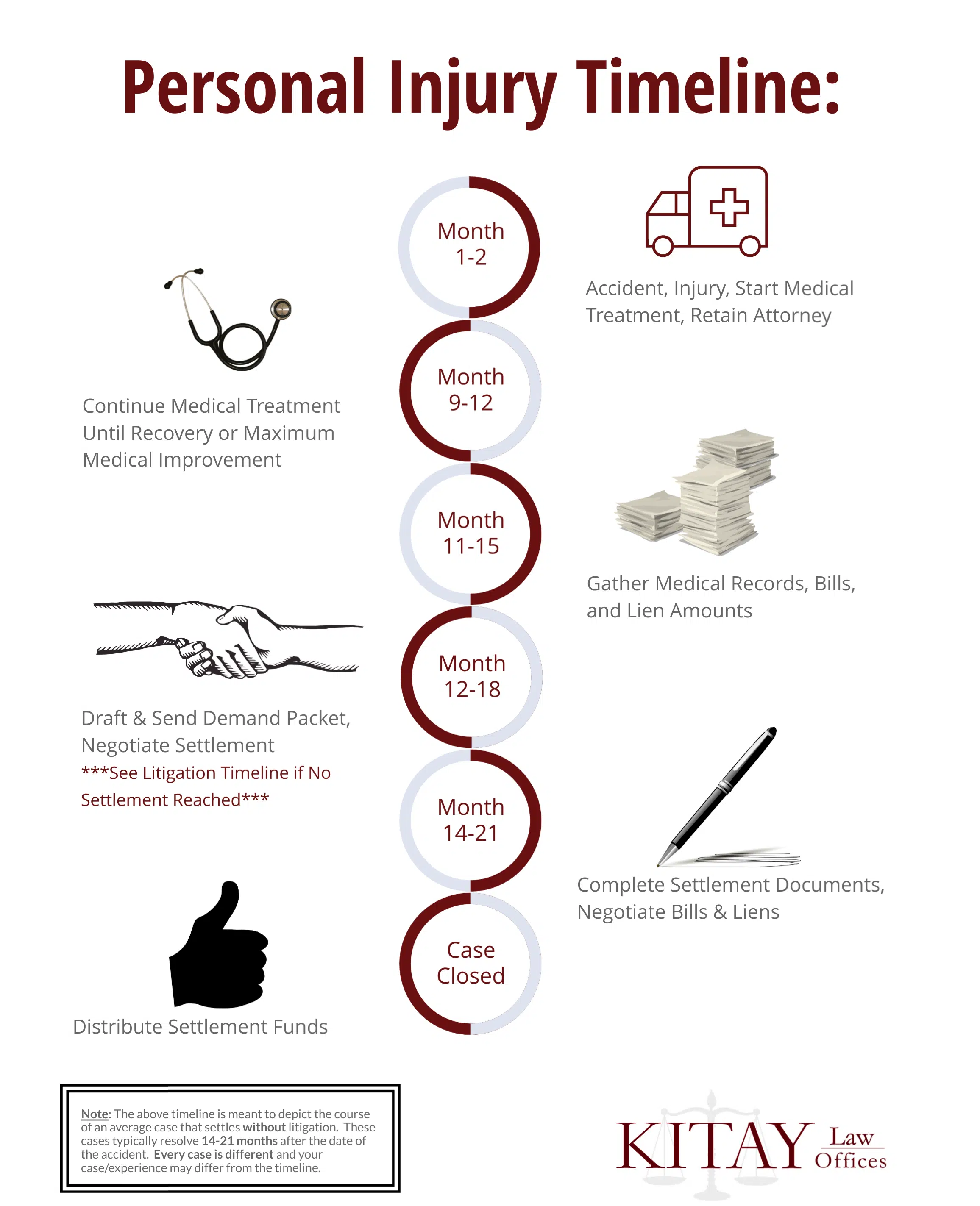
Print or Download: Personal Injury Timeline for Pennsylvania

Thomas J. Pivnicny, Esquire
Meet your personal injury attorney; Thomas J. Pivnicny, Esquire
Pennsylvania Personal Injury Attorney Thomas J. Pivnicny is a smart lawyer and critical thinker. In fact, his ability to work with insurance companies and other lawyers is excellent. As a result, he has won millions in personal injury settlements. He understands the personal injury timeline, and he will work hard to get you the largest compensation possible.
Thomas can be reached by calling 888-KITAYLAW.
